 Russell Andrews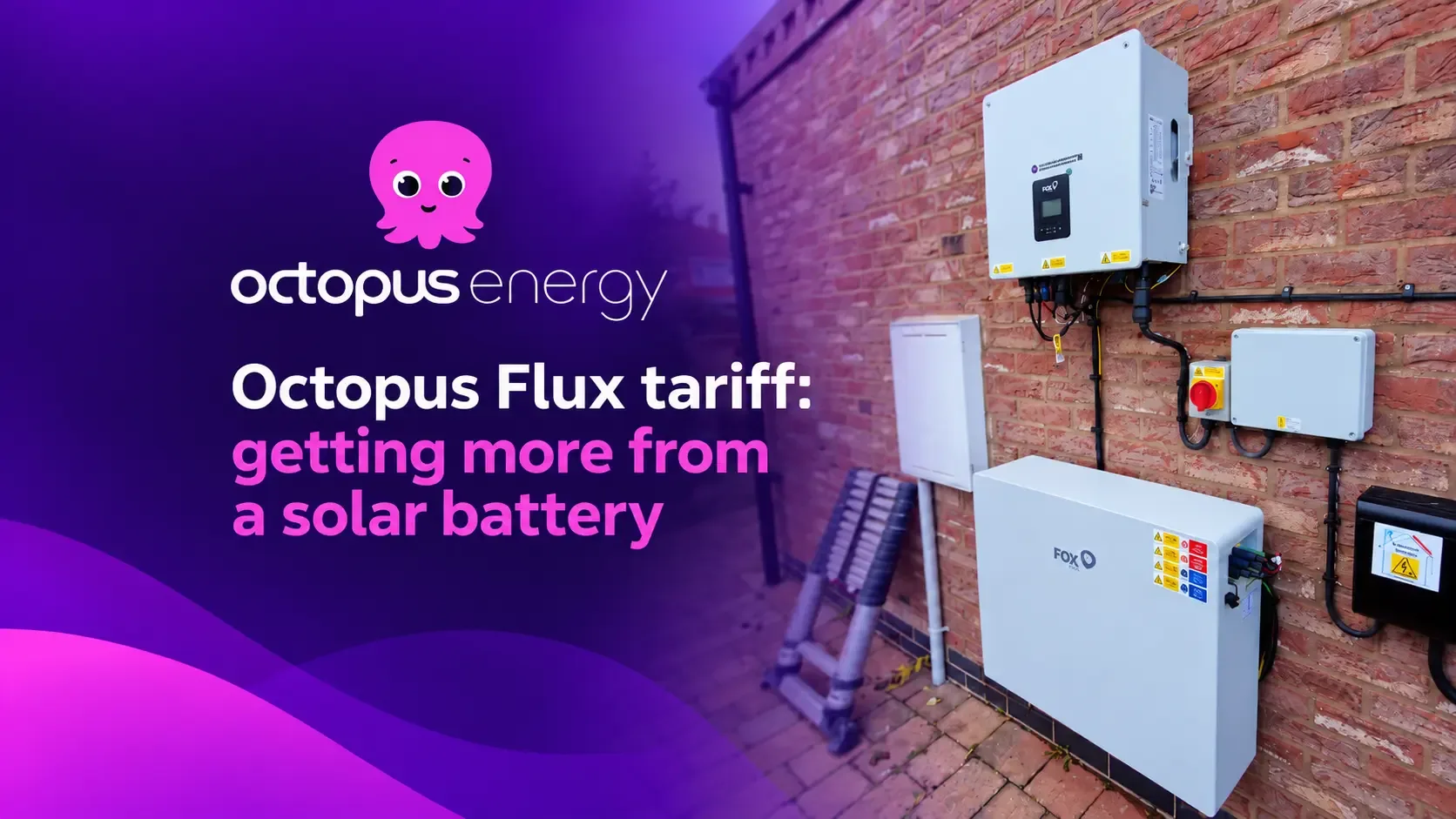
The Octopus Flux tariff can help a solar battery earn its keep through cheaper overnight charging and higher-value evening exports. But the useful measure is your total electricity bill, not export income alone. Our recommendation is to balance the electricity your home needs against what you could earn by selling it. Standard Flux leaves scheduling to you. (octopus.energy)
By Russell Andrews. Tariff information checked on 5 October 2026.
We install home battery storage alongside solar and related home-energy systems. This guide explains the tariff decisions around that equipment; Octopus sets its own prices, eligibility and account requirements.
How the Octopus Flux tariff works
Import means electricity you buy from the grid. Export means electricity you send back. Standard Flux combines both, with three daily pricing periods. As checked on 5 October 2026, its published schedule is: (octopus.energy)
UK local timePricing periodBattery consideration02:00 to 05:00Lower import and export ratesConsider charging for the coming day.05:00 to 16:00 and 19:00 to 02:00Day ratesBalance household demand and stored energy.16:00 to 19:00Peak import and export ratesUse stored energy and consider exporting surplus.
These windows follow UK local time throughout the year. Flux is variable, so obtain a current postcode-based quote rather than relying on an old screenshot. Record the standing charge and every import and export rate. (octopus.energy)
Who can join?
Octopus requires working solar panels, a home battery and a smart meter supplying half-hourly readings. Both electricity import and export must be with Octopus. Its terms also require solar installation certification under the Microgeneration Certification Scheme, plus the relevant G98 or G99 network connection documentation. (octopus.energy)
For our customers, the practical starting point is the equipment and paperwork, not the tariff headline. Keep your installation documents handy and confirm account eligibility directly with Octopus before changing battery settings.
Standard or Intelligent: check availability first
Standard Flux requires you to arrange charging and discharging through your battery controls. Intelligent Flux instead gives Octopus control of a compatible battery, including when it charges and exports. Its automation should not be confused with the standard tariff's overnight schedule. (octopus.energy)
Availability needs checking. On 5 October 2026, the Intelligent product page displayed conflicting notices: one said temporarily unavailable; another restricted access to customers buying solar and batteries from Octopus. We therefore would not recommend choosing equipment on the assumption that you can join it. Confirm your specific eligibility with Octopus first. (octopus.energy)
The same page warns that compatibility is not guaranteed. A supported brand name alone is not enough reassurance for a purchase decision. Check the exact equipment and connection requirements rather than assuming any internet-connected battery qualifies. (octopus.energy)
Choose how much control you want
Our advice is to decide whether you want to manage a schedule or hand control to the supplier. Under Intelligent's published terms, continuing control access is a condition of eligibility. That distinction matters if you prefer to manage stored energy yourself. (octopus.energy)
For the equipment side, explore our inverters and smart technology. Keep hardware selection separate from any assumption about future access to a particular supplier's automated tariff.
Build a schedule around your household
Time-of-use tariffs reward moving consumption into cheaper periods, but they can cost more if expensive imports outweigh the benefits. Our suggested starting point is your half-hourly consumption history: identify when the house needs electricity before deciding when to export. (energysavingtrust.org.uk)
Start with the evening, then work backwards
For a manually controlled system, use this planning checklist rather than copying another household's settings:
Estimate evening demand. Include cooking, heating and any electric car charging.
Set a sensible reserve. Decide how much stored energy you want available for household use.
Plan the overnight top-up. Consider expected solar generation before filling the battery from the grid.
Review actual results. Check imported electricity and export income together, then adjust your plan.
This is our suggested approach, not a universal operating schedule. Batteries store either surplus solar electricity or grid electricity for later use, so the right balance depends on your needs. (energysavingtrust.org.uk)
Allow for energy lost in storage
Storage is not perfectly efficient: less electricity comes out than goes in. For off-peak battery charging, divide the purchase price by the system's round-trip efficiency, expressed as a decimal. This gives the energy-only cost of each usable unit, before equipment wear and other costs. The calculation follows from the storage losses described by Energy Saving Trust. (energysavingtrust.org.uk)
Our rule for manual scheduling is simple: do not chase an export payment without considering the cost of replacing that electricity later.
Judge the whole bill before switching
Assess the Octopus Flux tariff against your existing arrangement using annual consumption, not just a sunny week's exports. Include standing charges, imports in each pricing window and solar export payments. Historical usage helps estimate outcomes, but future rates and savings are not guaranteed. (energysavingtrust.org.uk)
Older solar owners should check existing payments carefully. Octopus says Feed-in Tariff generation payments remain unchanged, but joining Flux replaces deemed export payments with metered export payments. Read our Smart Export Guarantee guide for export background before discussing the change with your supplier. (octopus.energy)
Planning battery storage for solar? Request a quote from us and share your electricity usage, existing equipment and future plans. Start with a system that suits your home, then assess the tariff around it.