
 Russell Andrews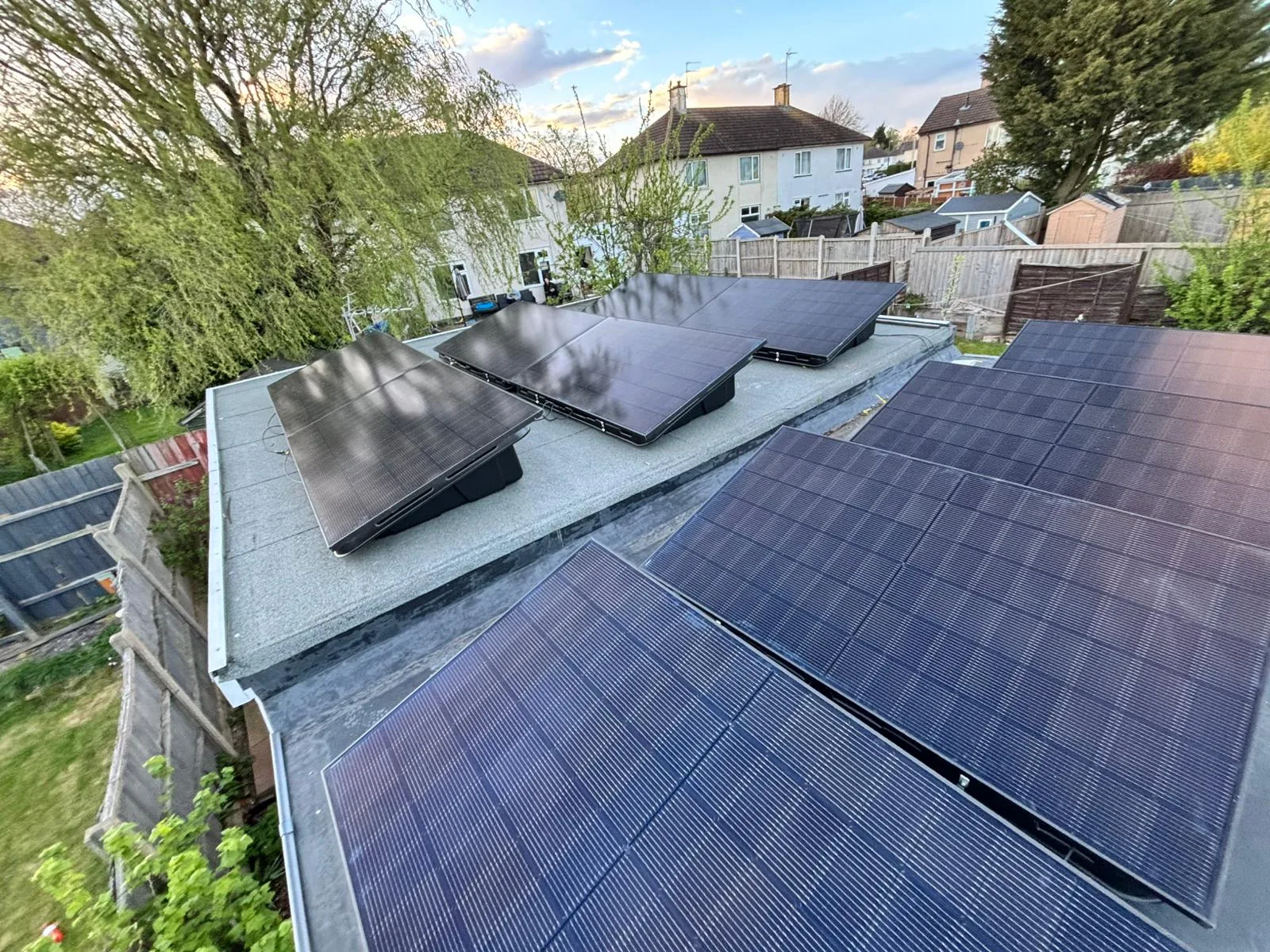
Our starting advice on flat roof solar mounting is straightforward: panels can work on a suitable flat roof using weighted frames or appropriate fixings. The choice depends on roof strength and waterproofing, not simply the available space. Panels are normally tilted rather than laid directly against the roof covering.
We use Clenergy mounting systems, including for flat-roof installations. If you are considering our residential solar installations, this guide explains the mounting decisions worth understanding before you commit.
By Russell Andrews. Updated 9 September 2026.
How flat roof solar mounting works
Ballasted frames
Ballast means weight used to hold the mounting structure in position. A ballasted solar mounting system uses purpose-designed supports and weights, such as concrete blocks. Clenergy's flat-roof range includes systems using this approach.
The attraction is avoiding fixings through the waterproof covering. However, that added weight still needs structural assessment; a non-penetrating system is not automatically suitable for every roof.
Mechanically fixed supports
Another approach secures supports with fixings rather than relying on ballast alone. Suitable fixings and weatherproof detailing are essential to prevent leaks. Energy Saving Trust identifies this as an option where a roof cannot accommodate a weighted system.
Our recommendation is to settle the roof requirements before choosing between these approaches. Treat mounting as part of the building design, not an accessory selected after the panels. A useful proposal should make the chosen method understandable, including why it suits your particular roof.
Roof strength, wind and waterproofing come first
Solar panel roof loading includes more than the panels themselves. Clenergy's installation guidance requires consideration of the mounting system, ballast, wind and snow, alongside the roof structure's capacity. Its ballast calculations also account for location, building height, layout and roof surface.
That is why we recommend avoiding generic claims about a safe ballast weight per panel. Bring any structural drawings or previous roof reports to your discussion with us. Where capacity is uncertain, resolve that uncertainty through a structural assessment before proceeding.
Protect the covering and drainage
The protective material beneath a mounting system must suit the roof covering. Drainage must remain unobstructed, and the layout needs maintenance access. Clenergy also highlights higher wind loads around roof edges and corners, making positioning a design consideration.
For an ageing roof, consider repairs or renewal before installation. Energy Saving Trust notes that renewing the covering first is sometimes recommended to keep it in good condition beneath the panels.
Before committing, we suggest recording three things: the evidence supporting roof suitability, responsibility for any roofing work, and the agreed waterproofing details. Keep those records with your installation paperwork rather than relying on a verbal reassurance.
Choosing the layout and checking permission
There is no universal panel angle
The flat roof solar panel angle depends on the selected mounting arrangement. For example, Clenergy's published Ascent brochure describes 10-degree and 15-degree options, while its wider range includes an east-west alternative. These are product examples, not a promise that either arrangement suits your property.
Our advice is to review a drawn layout alongside the proposed equipment. Request clear labels for panel positions, rooflights, drainage and access routes. For projects involving our commercial solar installations, bring details of existing rooftop equipment into that conversation too.
Keep the discussion focused on the whole roof, rather than the largest panel count. Ask us to explain the proposed orientation and the assumptions behind the generation estimate before treating that estimate as a basis for your decision.
Planning rules depend on location
As checked on 9 September 2026, England's domestic permitted development guidance sets a 600mm flat-roof height limit above the roof's highest part, excluding chimneys. Other conditions apply, including prior approval requirements for flat-roof installations on certain designated land. The height limit alone does not establish permission.
That guidance covers England, not the whole UK. Confirm the applicable position with your local planning authority, particularly for protected buildings or locations. Leaseholders should also establish whether permission is needed from their landlord, freeholder or management company.
What to resolve before requesting a quote
For a flat roof solar installation, we recommend a scope-based budget rather than a headline mounting-kit price. Put the following questions on your project checklist so the discussion covers the complete job:
Which mounting arrangement is proposed, and why?
What roof information or structural assessment is still needed?
Does the scope include any necessary roof preparation?
How are safe access and lifting arrangements addressed?
What electrical work is included?
Which permissions and third-party costs remain outstanding?
Ask for inclusions and exclusions in writing. Separate essential work from optional additions, and avoid using a generation estimate as a substitute for understanding the installation scope.
To discuss flat roof solar mounting with our team, get a free quote. Share your address, approximate roof dimensions, covering type and any roof drawings you already hold. Photographs taken from a safe location are useful for an initial conversation; please do not climb onto the roof to obtain them.
There is no need to choose a mounting kit before contacting us. Start with the roof information you have, explain how you use the building, and highlight any planned roofing work.